


Apple recently released the MacBook Neo, a delightfully colorful and extremely popular laptop with moderately low-end specs. Priced at only $599 ($499 with an education discount), t’s so popular that it’s often sold out — despite being the slowest model in Apple’s laptop lineup. (It actually uses an iPhone CPU and 8 GB of RAM.)
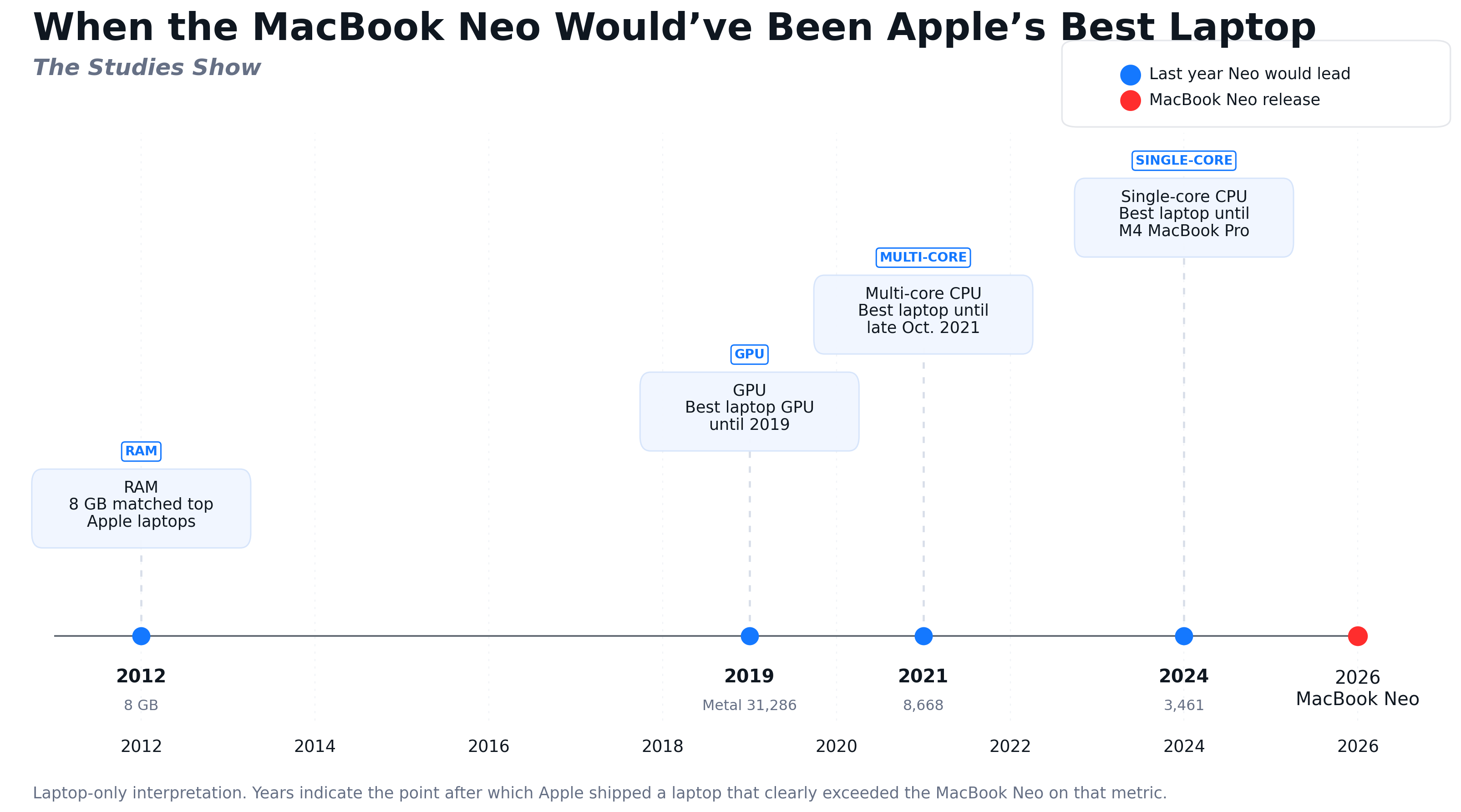
But what if you had a time machine? How far back would you have to go for the MacBook Neo to be Apple’s best laptop — or best computer?
It’s a fun hypothetical with a shocking answer: By some measures, only a couple years.
And that’s why this is such an interesting question -- it shows just how fast technology is advancing. This article will compare, stat by stat, how long ago the MacBook Neo is Apple’s fastest computer based on various specs, as well as discussing the underlying technological process that got us here. Let’s dive in:
The MacBook Neo’s headline numbers, via the Geekbench Browser, are:
- Single-core CPU: 3,461
- Multi-core CPU: 8,668
- Metal GPU: 31,286
- RAM: 8 GB unified, soldered, no upgrade option
Now, in time-machine order:

Single-core: 2024 (Laptop and Desktop)
On single-core performance, the MacBook Neo would have been Apple’s highest-scoring laptop as recently as November 2024 — i.e. up until the moment Apple shipped the M4 MacBook Pro.
This is basically the most insane benchmark in the article. The Neo’s 3,461 single-core beats:
- The M3 Max 16-inch MacBook Pro (single-core ≈ 3,128) — Apple’s flagship laptop, originally released in 2023, which retailed for up to $7,200.
- The M3 Ultra Mac Studio (single-core ≈ 3,202) — Apple’s desktop flagship, released March 2025 and starting at $3,999.
The $599 fanless laptop has higher single-thread performance than both the $7,200 laptop workstation and $4,000+ desktop workstation Apple was selling to professionals basically a year ago. It only loses single-core to the M4 generation that began shipping in November 2024 and the M5 generation that followed. Of course, the Neo is fanless, and so would not sustain long-term performance like a Mac Studio would. But it is still shockingly impressive.
Multi-core: 2021 (Laptop), 2017 (Desktop)
For the Macbook Neo to be Apple’s fastest laptop measured by multi-core performance, you need to go to 2021. That’s because the MacBook Neo scores better on multi-core than any Intel laptop. It’s also barely better than the base M1 chip.
The Neo (8,668 multi) beats:
- The M1 MacBook Air / Mac mini from late 2020 (≈ 8,191 multi) — barely, by around 6%.
The M1 Pro / M1 Max MacBook Pro shipping on 26 October 2021 is the first MacBook generation to clearly clear the Neo on multi-core. So in laptop-only terms, the Neo would have been Apple’s best multi-core laptop until late October 2021.
But what if we raise the stakes and compare the Neo to desktops?
The Neo clears the:
- The base 2017 iMac Pro (8-core Xeon W-2140B, ≈ 7,367 multi).
- The base 2019 Mac Pro (8-core Xeon W-3223, ≈ 7,303 multi).

But, it loses, but only barely, to upgraded 2017 iMac Pro configurations:
- iMac Pro 14-core: ≈ 9,020 multi
- iMac Pro 18-core: ≈ 9,918 multi
In multicore performance, Apple’s cheapest 2026 laptop is basically competitive against Apple’s high-end, upgraded desktops from 2019. Which is wild.
Once again, we need to caveat with the fanless architecture, but it’s important to note that fanless is a choice made by Apple, not a hard design limit of the chip itself.
GPU: 2019 (Laptop)
If single-core is where the Neo is most absurdly impressive, GPU is where it’s most ordinary.
Apple doesn’t market the Neo’s GPU as a monster. The chip has a 5-core A18 Pro GPU — basically an iPhone-class GPU — and the Geekbench 6 Metal score of 31,286 reflects that. Compared with the rest of Apple’s lineup:
- iPhone 16 Pro: 32,575— the Neo is somehow slower than its own donor phone.
- M1 MacBook Air, 2020: 33,148 — the Neo is slower than a 2020 entry-level Apple laptop.
- 2019 16-inch MacBook Pro w/ Radeon Pro 5500M: 36,145 — the Neo loses by ~16%.
- M4 MacBook Air, 2024: 54,630 (~75% faster than the Neo).
- M3 Max MacBook Pro: ≈ 155,991.
- M3 Ultra Mac Studio: ≈ 259,668 (~8× the Neo).
Translation: in the laptop-only time machine, the Neo would have been Apple’s best laptop GPU only until November 2019, when the 16-inch MacBook Pro shipped with the Radeon Pro 5500M. Every Apple Silicon MacBook ever sold also beats the Neo on Metal GPU performance. This is the one part of the chip that genuinely feels like an iPhone in a laptop.
(The late-2018 15-inch MacBook Pro could be configured with a Radeon Pro Vega 20 BTO option, which may also have edged the Neo, I just wasn’t sure so I went with 2019. If someone can confirm in the comments I’ll change this to 2018.)
RAM: 2012 (Laptop), and 2003 (Desktop)
So how long ago was it that 8GB of RAM was the highest spec Apple laptop option?
MacBook Neo’s 8 GB matches the highest-end official Apple laptop configurations from around 2012. The non-Retina MacBook Pros of mid-2012 officially supported 8 GB; on 11 June 2012 Apple shipped the Retina 15-inch MacBook Pro, configurable to 16 GB soldered, and the (time-traveling) Neo lost the laptop RAM crown forever.
In laptop-only terms, on RAM, the Neo would have been competitive with Apple’s best laptops until mid-2012 — about fourteen years ago.
On the desktop side, you’d have to go all the way back to June 2003, when the original Power Mac G5 first reached an 8 GB RAM ceiling. Before that — including the entire Power Mac G4 era of 1999–2003 — Apple’s flagship desktop topped out at only 2GB.
So a 2026 MacBook Neo would have had quite a bit more RAM than any Mac Apple sold until 2003.
Price
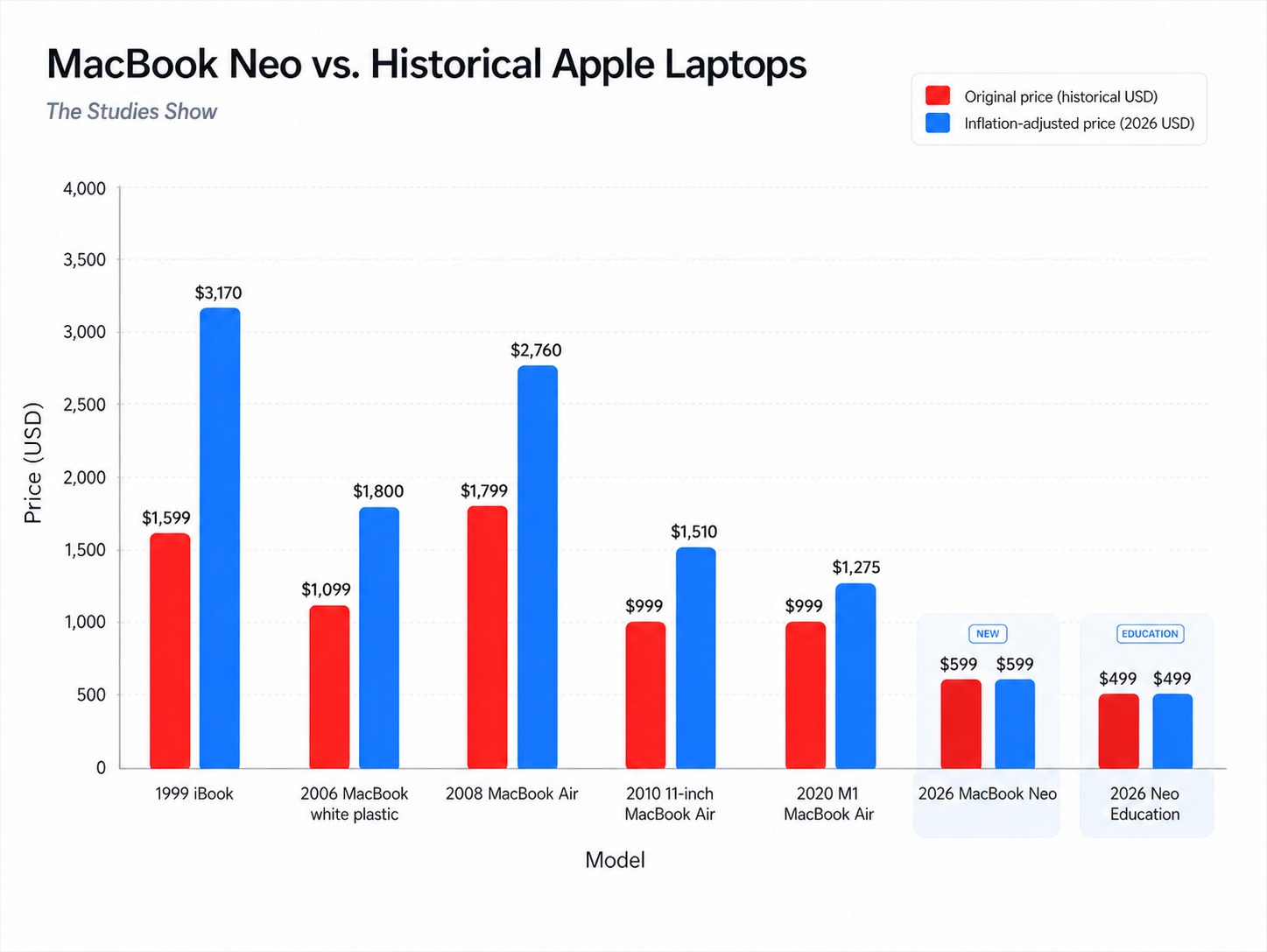
Adjusted for inflation, the Neo is very likely the cheapest Apple laptop ever, and maybe the best value laptop computer of all time.
In 1999, you needed to spend the equivalent of about $3,170 in 2026 dollars to get into the Apple laptop ecosystem — and the machine you got, the 1999 iBook Clamshell, was far, far worse than the Neo on every dimension. Today you can spend about 19% of that — or 16% with an education discount — to walk out with a vastly more powerful (and more colorful) MacBook Neo.
Roughly, using U.S. CPI inflation:
- 1999 iBook ($1,599) → ~$3,170 in 2026 dollars.
- 2006 MacBook white plastic ($1,099) → ~$1,800 in 2026 dollars.
- 2008 MacBook Air ($1,799) → ~$2,760 in 2026 dollars.
- 2010 11-inch MacBook Air ($999) → ~$1,510 in 2026 dollars.
- 2020 M1 MacBook Air ($999) → ~$1,275 in 2026 dollars.
- 2026 MacBook Neo: $599. Or $499 with education.
The Neo is roughly $700 cheaper, in real terms, than the M1 MacBook Air was at launch five years earlier — and the M1 was already considered the value benchmark in laptops. It’s about $2,570 cheaper, in real terms, than the iBook of 1999, while being faster than every Mac Apple sold for most of the next two decades.
So, we get it. The Neo is awesome. But is it just Moore’s Law? Was this all inevitable?
No.

Why is this happening? It’s not really Moore’s Law.
A reasonable first guess is that the Neo crushes a 2017 iMac Pro on single-core because of Moore’s Law — twice as many transistors every two years, repeated for nearly a decade, eventually adds up. But that’s not really what happened, and the actual story is interesting.

Moore’s original observation was about transistor *density*, and that has broadly continued. The 2017 iMac Pro’s Xeon W chips were built on Intel’s 14 nm process; the A18 Pro in the Neo is on TSMC’s 3 nm-class N3E. By transistor count, the A18 Pro packs roughly 20 billion transistors into a phone-sized chip. Density did its job.
But Moore’s Law alone doesn’t translate to single-thread speed. That used to come from a separate effect called *Dennard scaling*: as transistors got smaller, you could clock them faster at the same power. Dennard scaling broke around 2005–2006 because of leakage current at small feature sizes, and clock speeds have crept rather than leapt ever since. The 2017 iMac Pro’s top Xeon ran at up to 4.5 GHz boost; the A18 Pro runs at about 4.0 GHz peak. Clock speed isn’t doing the work.
So what is? Roughly four things:
Wider, smarter cores.
Apple’s performance cores are unusually wide — the M-series and A-series chips can decode 8+ instructions per cycle and have very large reorder buffers, vs ~4 wide on the 2017 Xeons. This is architecture, not Moore’s Law. Most of the per-core speedup since 2010 has come from ARM-style design choices that Intel underinvested in.
Memory hierarchy.
The Neo’s unified memory sits inches from the SoC; bigger on-chip caches and faster memory paths matter enormously for real-world code.

Specialized accelerators.
Some of what Geekbench measures runs on dedicated hardware blocks — image processing, cryptography, machine learning. The A18 Pro has fixed-function silicon for these that the 2017 Xeon simply doesn’t.
Power efficiency, finally cashed in.
Phone chips were designed under brutal power budgets (2–5 W). When Apple ported that DNA to laptops with the M1, it turned out you could get desktop-class single-thread performance in a fanless package. The Neo is a more aggressive version of the same trick.
There’s also a market story underneath this. Intel’s Xeons had no real pressure to get dramatically faster because the workstation market didn’t punish stagnation. Apple’s iPhone chip team had brutal annual pressure from a billion-unit consumer market. A decade of that compounding produces, eventually, a $599 fanless laptop that beats a $7,000 workstation on the benchmarks that make computers most usable for most consumers.
The deeper point: the old-school understanding that exponential transistor density drives everything-else — is now wrong. Apple’s unique position and ability to innovate across multiple form factors is now truly paying off in a way that was impossible in the Intel (or PowerPC) eras.

Final thoughts
If you had a time machine, the MacBook Neo would be absolutely shocking to anyone coming from the Intel era, and totally astounding to someone from the early 2000s.
As they used to say, the Neo is inexpensive but not cheap. In fact, it’s basically just held back by the RAM configuration. A Neo with 16, 24, or 32 GB would be competitive into the 2020s on every metric except serious GPU performance, which is scary.

You can of course quibble about thermal architecture, screen size, screen quality. or other measures, but the reality is that the Neo is shockingly competitive with pro-level laptops from just a few years ago. It’s a real achievement by Apple, Tim Cook, John Ternus, and Johny Srouji, and their teams.
The Neo is in some ways an unbalanced machine — incredible single-core CPU performance, decent burst multi-core, a weaker GPU, and a tiny amount of RAM.
The truth is that if it had more RAM it would probably cannibalize even more of Apple’s higher-end laptops. It’s just that good.
Marty McFly, if you’re reading this and are considering taking a MacBook Neo back in your DeLorean, you’d be carrying a pretty capable machine.
This is an interesting way of thinking about this, and I’m interested in the subject, generally. However, as a non-specialist, I have trouble thinking about what tasks correspond to single threaded or multi thread performance in a way that corresponds to how I actually use the computer. I have a 2024 MacBook Air with 16 GB of RAM which I use to browse the Internet, play StarCraft, run Spotify, etc. I Code, but only in a really lightweight IDE (Rstudio) and use Claude Code. My intuition is that for those tasks, the amount of RAM matters a lot more than single core performance, but I don’t know. Is that the right way to think about what performance means to a casual user?