

One night stands are often positive and many don’t lead to regret, but heterosexual women enjoy them less — largely because men don’t make them orgasm
Despite their reputation as black holes of regret, one night stands are often positive for both men and women. 79% of participants in this study reported neutral to positive feelings about their most recent ONS, and nearly half (47%) reported no regret at all.

But there is a gender gap, and it’s specific to one pairing. Heterosexual women who slept with men reported significantly more regret than every other group. Men with women, women with women, and men with men all reported similar (low) levels of regret. The gap exists only when straight women sleep with straight men.
This matters because it suggests the regret gap isn’t something inherent about being female. If it were, women would probably show elevated regret in same-sex encounters too, and, in this paper, they don’t seem to. Instead, the gap appears to come from the dynamics of heterosexual encounters themselves. The researchers found that sexual satisfaction — particularly orgasm achievement — was the strongest mediator, accounting for roughly 49% of the gender gap. Men were also significantly more likely to receive oral sex (73% vs 46% of women), and receiving oral sex was the only sexual practice that independently predicted lower regret. So, straight men, take notes I guess.
But social factors also matter, and that’s kind of predictable. Decision autonomy, intoxication, and reputational concerns also contributed. Together, all these factors apparently explained 86% of the total gender difference, which is essentially full mediation, meaning once you account for the quality of the experience, being female no longer predicts more regret.
Controlling for personality (emotional stability) didn’t change the results, which further weakens the idea that women are just dispositionally more regretful.
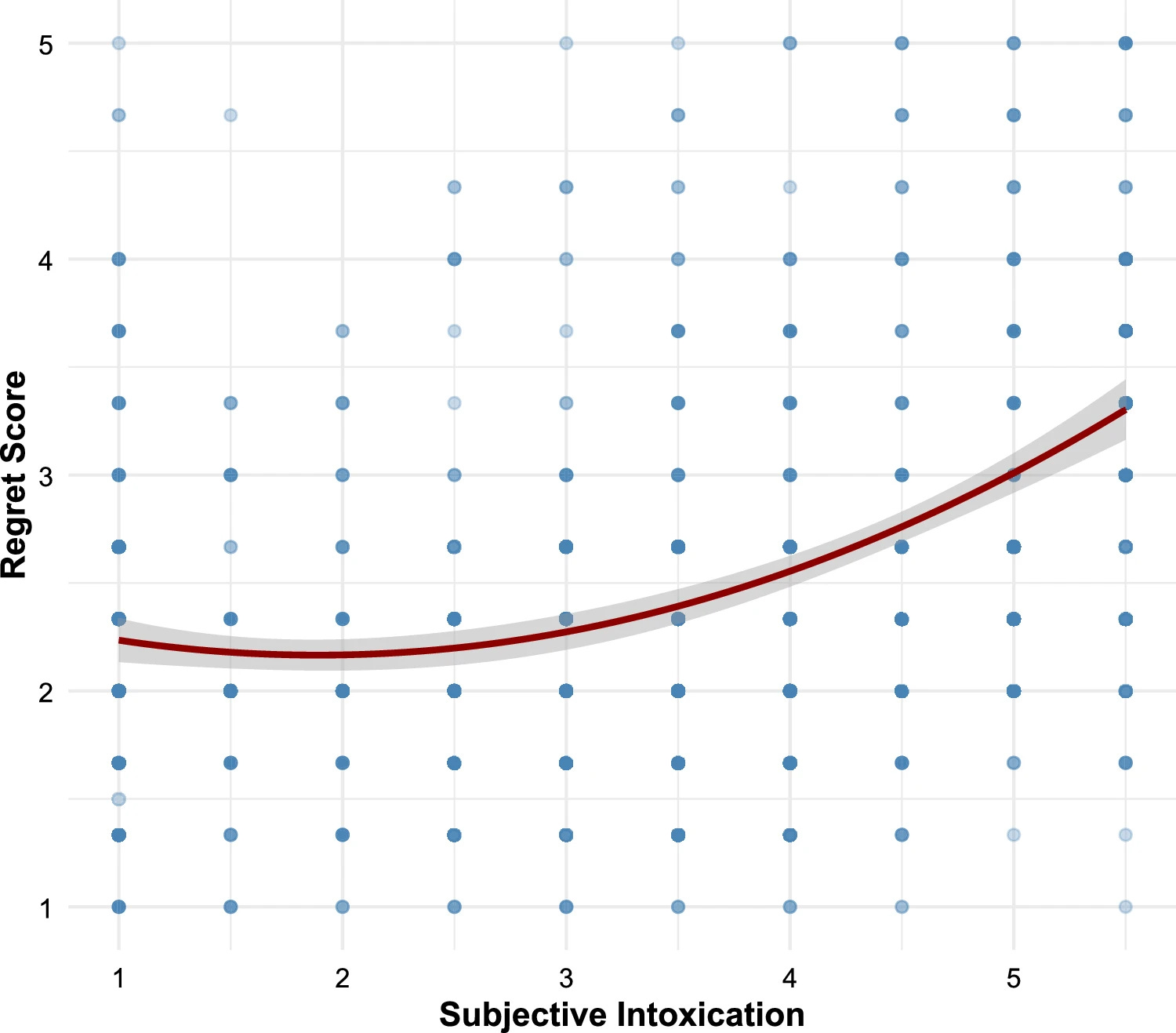
The influence of drugs:
75% of the sample were under the influence when they decided to have a one night stand. The substance was overwhelmingly alcohol (99% of those using substances), though 17% had cannabis (either alone or with alcohol), plus cocaine (3%), MDMA (2%), and amphetamines (1%).
Regret had an extremely slight U-shaped relationship on the left, that becomes pronounced with heavy intoxication. As the chart shows, the curve dips slightly at low intoxication levels before climbing sharply at higher levels. My guess is just that people comfortable with a drink or two are probably more relaxed (as a personality type and after the alcohol) than someone who is stone cold sober, but clearly more in control than someone who is hammered. And it goes without saying that at the high end of intoxication, there is probably even more possibilities for dark outcomes around sexual violence.

It doesn’t matter much if it’s a stranger or a friend, as long as you enjoy it.
Contextual factors, such as whether you knew the person, met them at a party vs. a date, were friends or strangers, didn’t seem to meaningfully predict regret. What mattered was the quality of the experience itself—satisfaction, autonomy in the decision, and not being excessively intoxicated. These findings held across Germans, Austrians, Americans, and Italians, and for both students and non-students. But as you can see, that is a pretty Western-centric sample. I’m genuinely curious if it would transfer to other cultures.
These patterns may not generalize to cultures with very different norms around casual sex. The study also only recruited people who’d actually had one night stands, which sort of underestimates regret since people who anticipate regretting casual sex may avoid it entirely. I guess you can’t regret what you don’t do, but the point is that the sample size is self-identified (at least somewhat) comfortable with casual-sex people.
And one other thing: Men who have sex with men were pretty satisfied, which undercuts a bit the idea men are just selfish lovers, which the heterosexual data somewhat suggests. It could just be that men are simple—easier to make orgasm. Or perhaps men understand other men well. Lot’s more to explore in this space.
Paper: The Gender Gap in One-Night Stand Regret: Evidence from Heterosexual and Same-Sex Encounters
Authors: Christina Sagioglou and Maximilian Dick

Broadband internet was pretty bad for American youth mental health
Girls were hit hardest via cyberbullying, while boys stayed up later.
A one-standard-deviation increase in state broadband access was associated with a 1.2-1.9% (9.3–16.5% increase) in adolescent suicide ideation, with girls being hit hardest.
This study covers 2009-2019, and as someone alive in the early 2000s, I will say many people got broadband way before 2009, so I bet we would have seen even more dramatic results if it started in say, 2000.
While effects appear for both sexes, the mechanisms differ strikingly by gender. For adolescent girls, broadband access increased cyberbullying victimization by 9% and made them 8% more likely to describe themselves as “overweight” (despite no actual change in BMI, which is perhaps the most heartbreaking part of this study.)
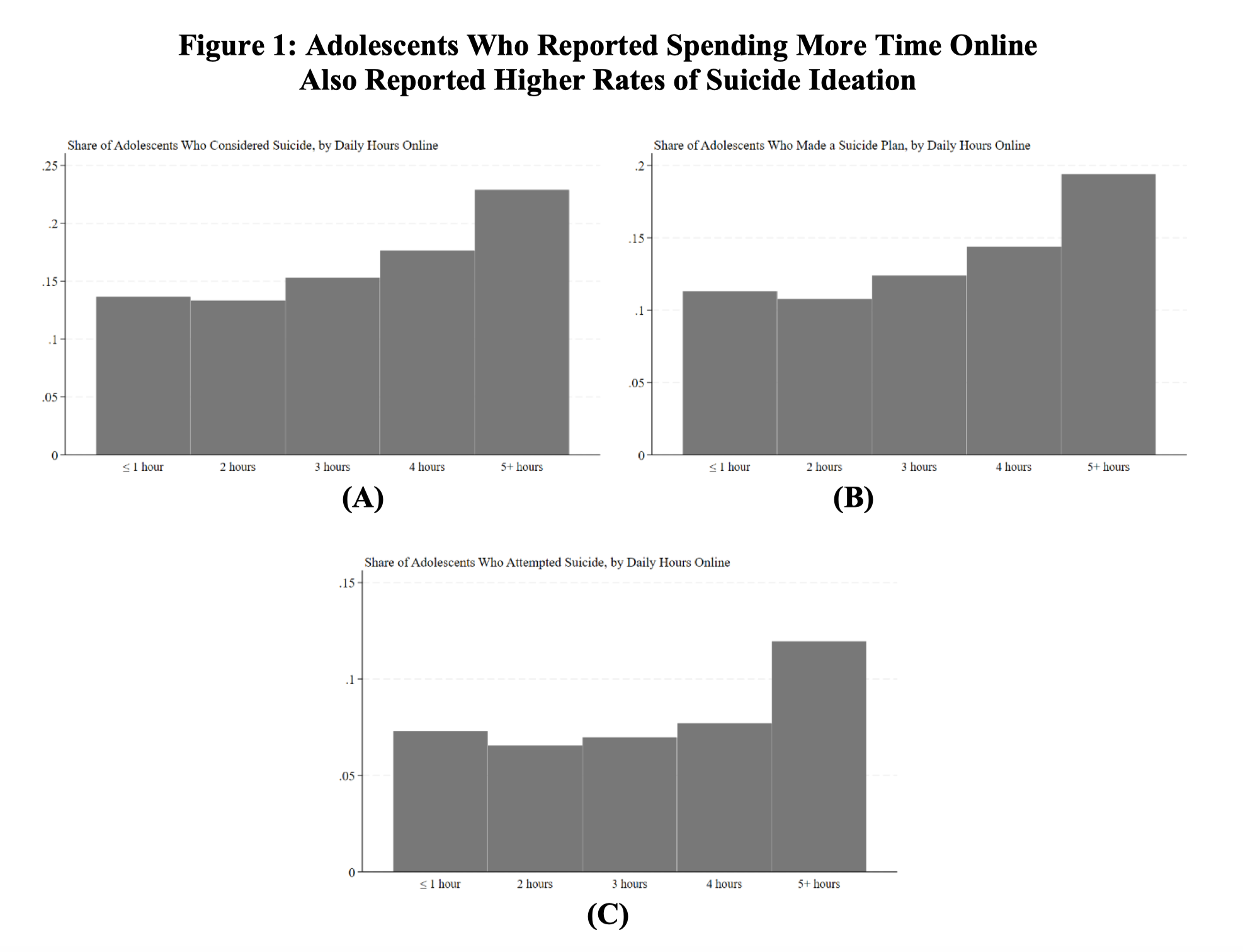
In contrast to girls, adolescent boys did not seemingly suffer from worse cyberbullying or body image issues. Instead, it affected their sleep. They were 9.9% less likely to report getting adequate sleep (17.2% for white boys specifically). Notably, the authors find that boys already at elevated suicide risk were most adversely affected—a pattern distinct from the more uniform downward shift in girls' mental health distribution.
Anyway, this paper also ends pre-covid and is essentially pre TikTok—it was just taking off at that time—so I think more research on this angle needs to be done, and is indeed being done.
Paper: Broadband Internet Access and Adolescent Mental Health in the U.S.
Authors: Brandyn F. Churchill & Kathryn R. Johnson

Poverty massively decreased from 1939 to today, but relative poverty is (slightly) worse today than in 1963
The authors note: “Relative poverty fell from 25.4 percent in 1939 to 19.5 percent in 1963, before rising to 20.8 percent in 2023.”
The main focus of this paper is the huge drop in poverty from 1939 to today, although in some ways I think the more interesting figure is the fact that relative poverty has increased from 1963 to today. After all, how people feel compared to others is hugely important for political and psychological reasons.
The headline findings of this paper show a dramatic number of people in poverty in 1939, just under 50% of the US population. But this appears to be because the poverty measure is indexed to 1963, and because 1939 was the end of the Great Depression, and featured lower living standards than the 1960s (of course).
The paper quotes Thomas Sowell a few times particularly to make the point that huge decreases in poverty took place from 1939, particularly among Black Americans, without government transfers.
Paper: Poverty and Dependency in the United States, 1939–2023
Authors: Richard V. Burkhauser Kevin Corinth

In China, people who plagiarized dissertations are more likely to become government officials, more likely to rise quicker once in the role, issue worse decisions that favor bigger interests, but live-streaming court proceedings somewhat mediates these poor rulings
Honesty matters but it’s hard to test over a career. These researchers found a way to do so by analyzing who plagiarized in their dissertations, then tracking who became judges, and analyzing their court rulings. While this paper looked at China I bet you could do this in other countries too.
The findings are striking:
Plagiarists are more likely to enter government service, and once in service, they are more likely to get promoted.
The authors ran a separate incentivized dice game and found that people who had plagiarized years earlier also cheated more on the dice game. But what people said about honesty was almost worthless to predict how they’d behave. The main exception was if they said hiring a ghostwriter was ok, it predicted dishonesty.
The rulings by judges who plagiarized are more preferential to big interests and more likely to face appeals, but live-streaming trials cuts this down. As the paper authors note “These results are consistent with dishonest judges being captured by powerful litigants when public scrutiny is low, a conjecture corroborated by subsequent corruption investigations.”
But the dishonesty doesn’t just stay in individual judges, it hurts entire institutions. Dishonest judges affect the actions of junior judges, and lawyers who plagiarize are more effective when faced with plagiarizing judges.
Finally the paper looks at newer efforts to stop plagiarism with detection efforts, finding reductions in plagiarism rates, and some reductions in judicial biases, suggesting injecting honesty into the system early may matter.
My guess is that these results would apply in many cultures, not just in China. China has a uniquely large population and sample size of cases, so I think we shouldn’t generalize to people based on cultural characteristics.
Paper: A Few Bad Apples? Academic Dishonesty, Political Selection, and Institutional Performance in China
Authors: Zhuang Liu, Wenwei Peng & Shaoda Wang
To be honest I was going to include even more papers but I didn’t want this to run too long. I’ll probably do this monthly from now on instead of every 2 months as initially planned.
Thanks for reading and see you soon
Alex