

We made a dating ‘net worth’ calculator. It’s available at datingnetworth.com in collaboration with Unusual Assets.
But before you slide anything, let us explain what it is, how it works, why it might be useful, and where it very much stops working.
How “Dating Net Worth” works
The calculator estimates a dating “net worth” from gender, age, attractiveness, height, income, and personality — with coefficients informed by published research on dating preferences. The result is shown as a dollar figure, but that figure is not what you are “worth” as a human (obviously).
Instead, the dollar figure is what economists call a shadow price: a fake-but-useful dollar value placed on something that does not literally have a market price. Dating markets do not actually exchange dollars for traits.1 The dollar figure is a metaphor for the relative scarcity and pull of certain traits inside an imaginary (but informed by reality) dating market.
So, what are the biggest takeaways from dating research? And how did we incorporate them into the calculator?
Research suggests money, height, age, and looks really do matter
It’s icky in some circles to openly state that things like height and money and youth matter in dating, but there is strong evidence that this really is true in the aggregate.
The findings the model leans on are some of the most replicated in social science:
Looks drive enormous effects in dating success.

Height and income matter a lot for men specifically; one famous anchor is Hitsch, Hortaçsu, and Ariely’s finding that a 5’6” man needed roughly $175K more income to match the desirability of a 6’0” man. (More on that finding here). Youth and physical appeal weigh more heavily for women, especially in the short-term market. And the gender asymmetry in casual dating is enormous: across dating-app data, women receive far more matches and messages than men do. Women get around 10x more messages and matches on dating apps then men do.2
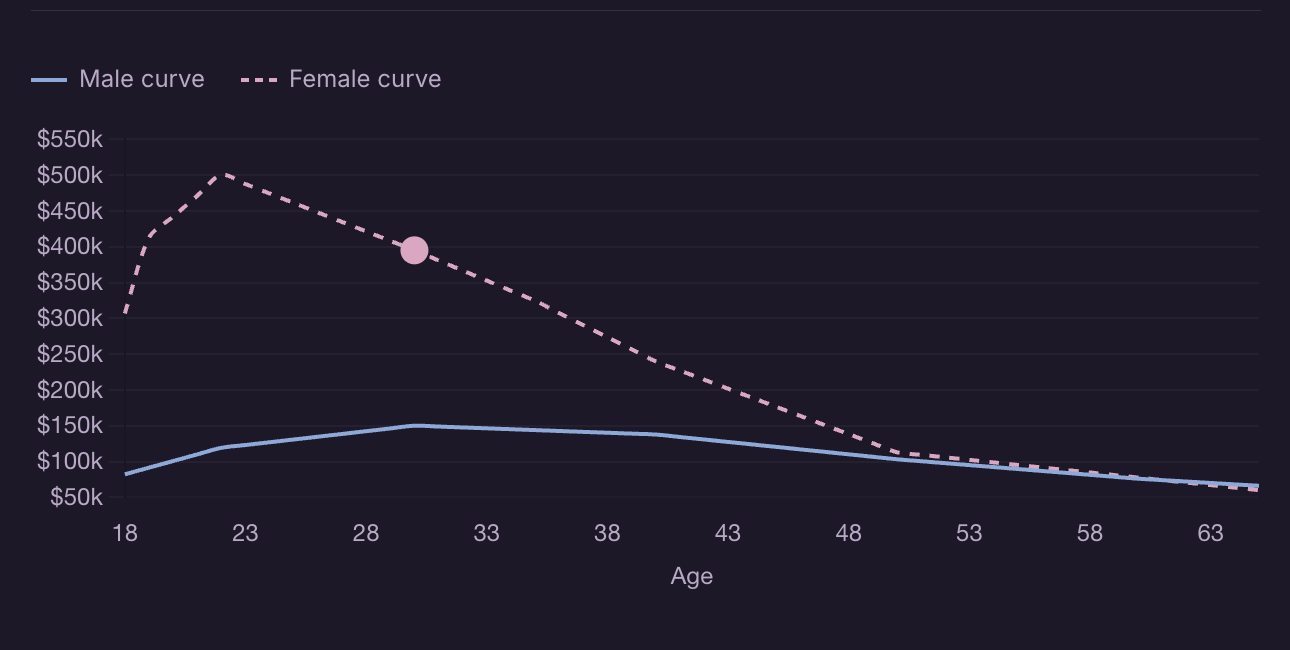
As a result, especially in short-term dating mode, women generally have a much higher ‘net worth’ than an otherwise similar male. (These two curves compare a man and woman of the same height and income, however, and the average man is both taller than the average woman and, in many cases, earns more).
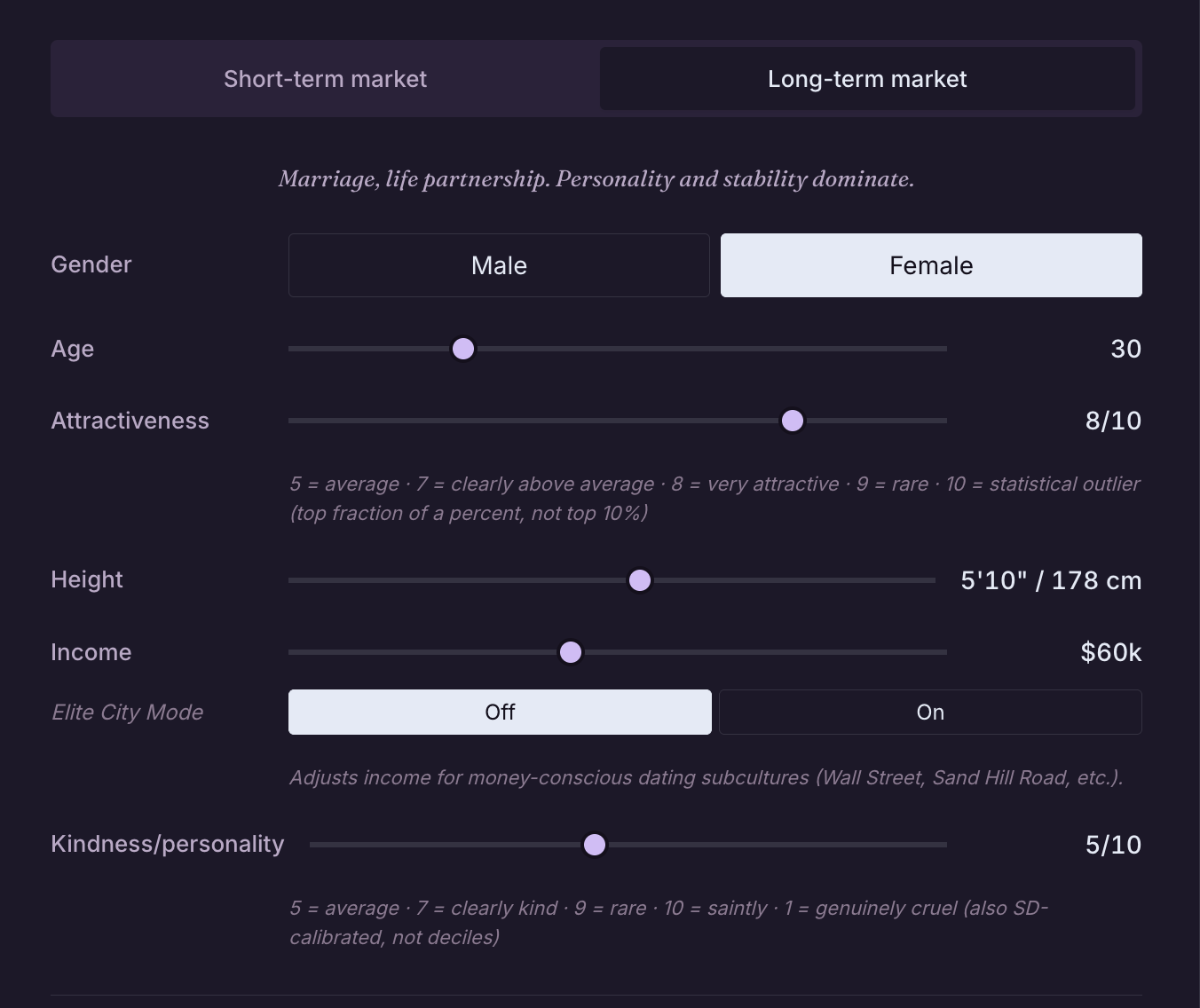
If you play with the calculator you can adjust height, wealth, attractiveness, personality, etc.
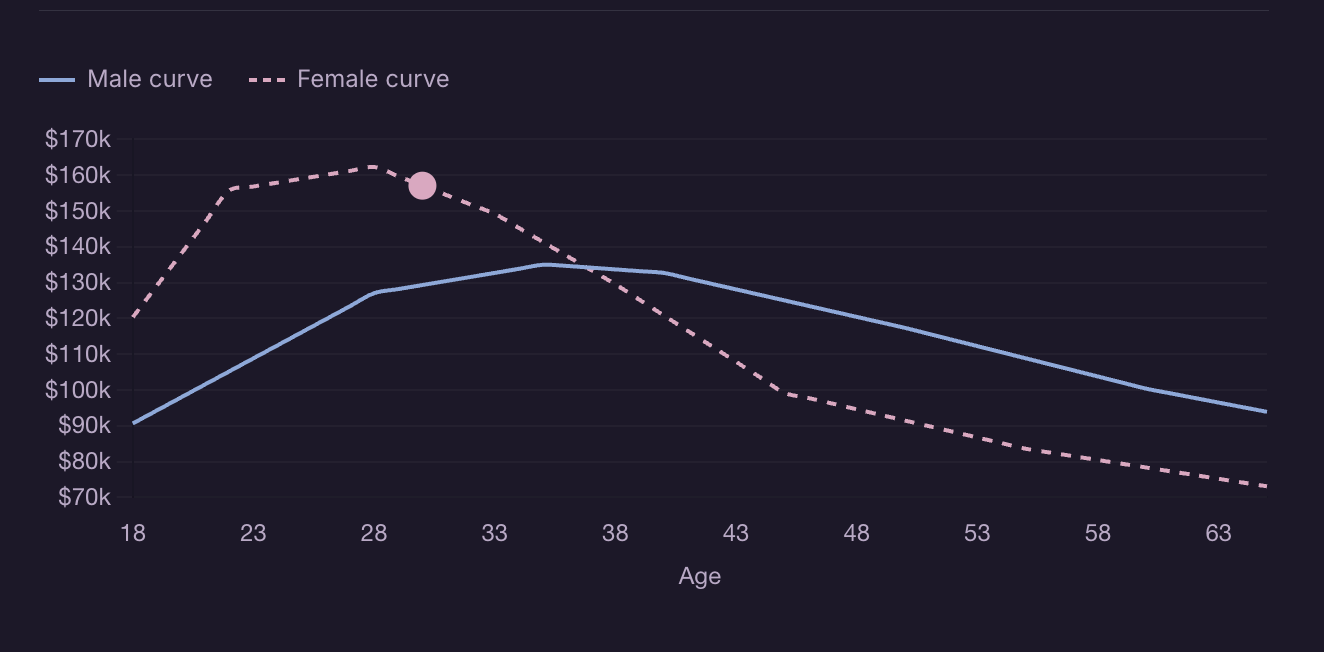
You’ll see that if you’re in long-term mode for men, extreme wealth provides far more points than it would for women, because of research suggesting women prioritize partner wealth more than men do in dating. Likewise, adjusting the slider to make a woman shorter has little effect, but, past a certain point, this heavily affects male scores as most women claim they want to date men their height or taller.
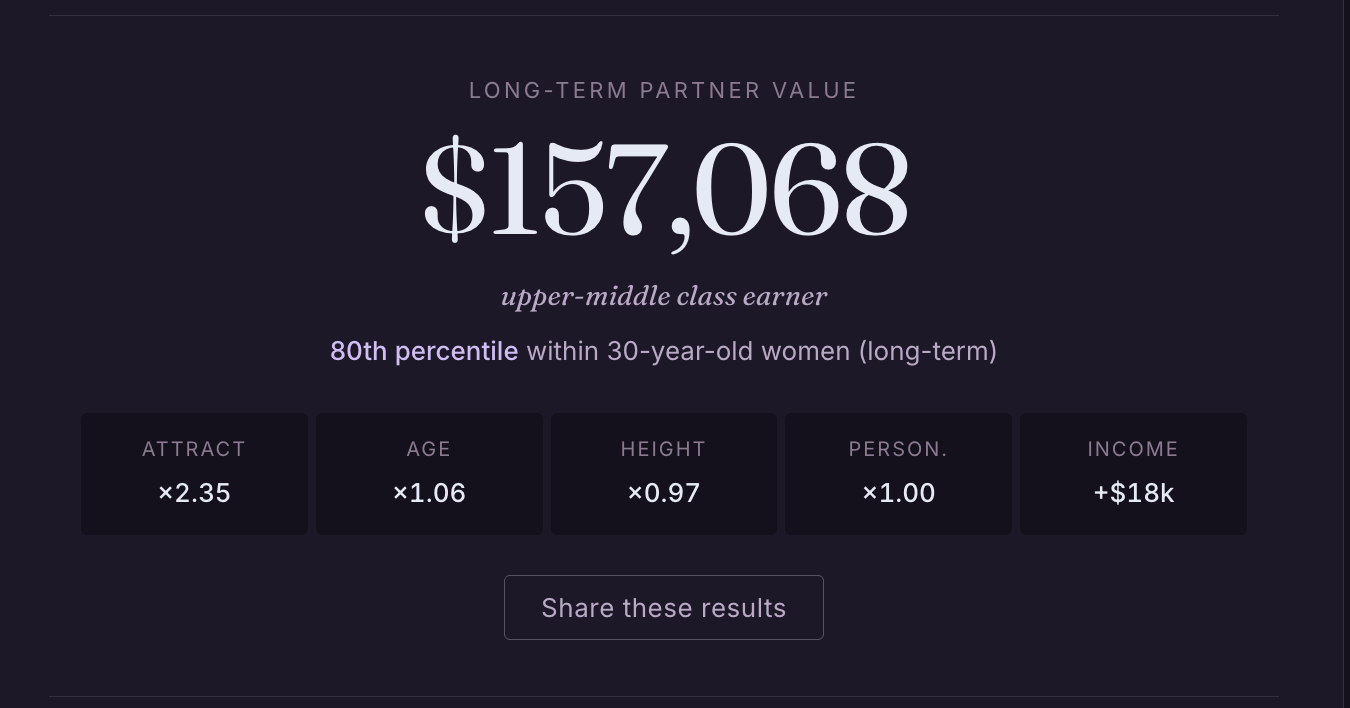
Combined, all of these attributes create a ‘net worth’ value, which, as stated, is just a shadow price. This is v1 of the calculator, and we may change this to move away from a money figure as it was confusing to some early testers. To reiterate, this is not a judgement of someone’s value as a person, but simply one economics tool for comparing an intangible asset. One person on reddit suggested we change it to a ‘stock price’ model and we may do that.

Anyway, beyond the model.
All of this doesn’t mean you can’t fall in love if you have less money, or are shorter or older than average. Plenty of people do, and will. And, the calculator is an approximation, not a verdict on you as an individual. That’s because:
No model can truly capture real world dating dynamics
Although it is research-informed, the calculator contains a large dose of approximation on our part. We took a body of research, made judgment calls about the size of different effects, and turned those judgments into sliders. Some coefficients are more strongly anchored than others. Height and income for men are relatively well supported. The effect of women’s height, high female income, and the exact steepness of attractiveness curves are closer to informed guesswork. I doubt it works for dating by the very religious. It might break down outside Western culture. It definitely doesn’t work for non heterosexual dating. We are missing a lot. And while the model is research-informed, it doesn’t use the exact data from research.

Strengths and weaknesses of the model
Its strength is that it makes some hidden incentives visible. It lets you test rough tradeoffs: short-term vs. long-term markets, looks vs. income, age curves, personality effects, elite-city assumptions. It is a rough approximation of reality, but not a totally meaningless one.
Its limits are just as important. It cannot see chemistry, religion, education, politics, class, subculture, bisexuality, polyamory, geography, attachment style, fertility goals, timing, emotional stability, or whether someone sends the right song at 2 a.m. It treats traits as cleaner and more separable than they are in real life. It relies mostly on US-style, online, heterosexual dating research.
It’s also important to remember that people are famously bad at rating themselves. (Men, in particular, are usually overconfident). So read the result like a provocative graph: interesting, imperfect, directionally revealing, and absolutely not the final word on your dating prospects.

I hope it it tells you something about the world dating research seems to describe. But just as importantly, no calculator can tell you what you should look for in a partner. And remember, although dollars are used in an academic economics sense, it does not calculate anyone’s true value as a person—which is infinite.
One final note. You might notice how, if you put your attractiveness / personality all the way up to 10 your “net worth” skyrockets.
That’s good news, because, if you want a relationship, it doesn’t matter if lots of people think you’re a 10—you only need to find one person who thinks you are.
Check out the Dating Net Worth experimental calculator here. Check out Unusual Assets, a newsletter about weird things that gain and lose value, here.
If you’re very interested in dating, I also recommend following Lana Li who writes Love Me Like a Robot which is a great newsletter exclusively on dating/data.
Thanks for reading The Studies Show, started by Alexander Webb, PhD, in early 2023.
Also consider reading this post on Unusual Assets about the value of male height quantified as a dollar figure.

One possible exception to this is in the case of prostitution or “sugar dating”. But we didn’t incorporate this into the model.
On that note, and in line with the above footnote, the other icky-but-true thing is that the centuries-old existence of prostitution (which is overwhelmingly straight men paying for short-term sexual access to women) strongly does suggest women have far more “net worth” in what could euphemistically be called ‘short term dating’ than men do. If you use the calculator, you’ll see that in most cases, women have far more ‘short-term’ dating ‘net worth’ than a similar man does. This comes from the fact that women get 10x more messages on dating apps, but the existence of prostitution as almost always paying for access to women is further evidence. Of course, the sexist and (often, very) unequal state of most societies throughout history also plays a key role in dating and sexual relationships between men and women, and not all of these relationships are consensual.
I’m obsessed w this. 26 yr old woman in LA and I got top 5%!!! Made me feel better despite the fact that my dating life feels dead on arrival. Medium hard to get a date and then extremely difficult to feel a real connection, flow, chemistry etc with someone. Lots of people who are very nice and good and normal but feels like talking to a pleasant co-worker—after some hours I’d probably get really annoyed. every 1-2 years I do encounter someone who feels like they could be the real deal. and at least im in the top 5%. I guess my q is, does the ranking matter? I mean it would be easy for me to get married, yes. I get a lot of likes on apps. But so what? Idk if those people actually would deeply care about me or be interested or if they just want a body and the convenience of having a girlfriend. I know so many people more so in the middle range, like 50th percentile, who are actually in loving committed relationships.
I find it interesting that, as a 54 year-old male, my ‘long-term’ worth is 55% greater than my ‘short term’ worth. I mean, considering that in the long term my career will have plateaued by this point, I am far less likely to want to start a new family, my likelihood of fathering healthy children (even with a much younger woman) is reduced, my current wife is still alive, my risk of serious health concerns and cognitive decline is elevated, and other nebulous details such as having ‘old man smell’ to look forward to.